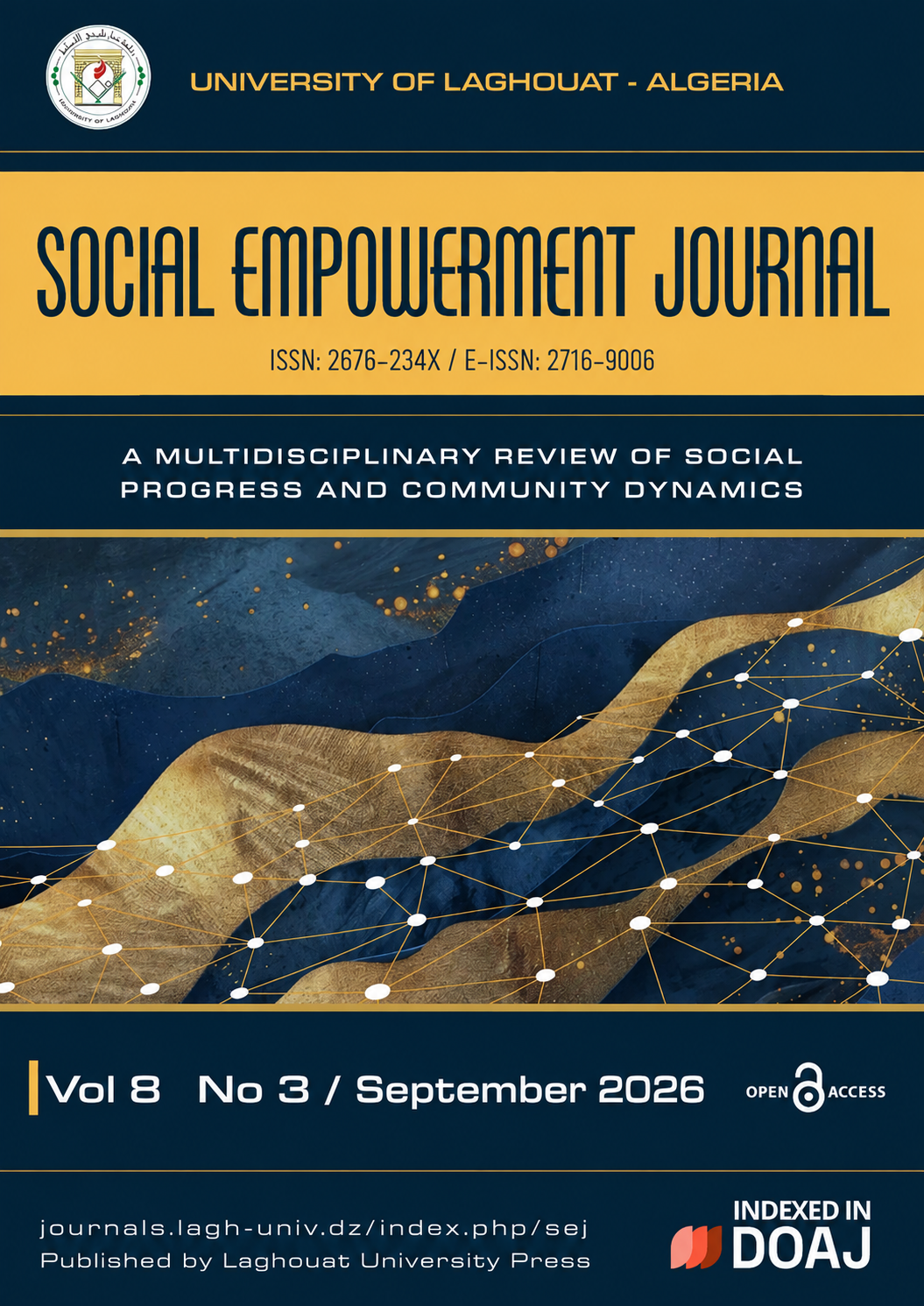
Public Works Programmes and Social Empowerment among Beneficiary Communities in Mpwapwa District, Tanzania
Abstract
Public Works Programmes (PWPs) have increasingly been recognized as important social protection interventions that contribute not only to employment creation but also to broader social empowerment outcomes. However, empirical evidence on their contribution to social empowerment in rural Tanzania remains limited. This study examined the contribution of Public Works Programmes to social empowerment among beneficiary communities in Mpwapwa District, Tanzania. A descriptive research design employing both quantitative and qualitative approaches was adopted. The study involved 300 household heads selected through simple random sampling for the quantitative component and 10 Public Works Programme beneficiaries purposively selected for qualitative interviews.Primary data were collected using structured questionnaires and interviews, while secondary data were obtained through document review. Quantitative data were analyzed using descriptive statistics, whereas qualitative data were subjected to content analysis. The findings indicate that respondents perceived Public Works Programmes as contributing to several dimensions of social empowerment, including community participation (78.0%), improved social status of beneficiary households (80.7%), strengthened social networks and support systems (63.5%), and stronger connections with local governance and development initiatives (83.5%). Qualitative findings further indicated that beneficiaries associated programme participation with increased confidence, social recognition, civic engagement, and stronger interpersonal relationships. The study concludes that Public Works Programmes are associated with important dimensions of social empowerment among beneficiary communities, extending beyond their role in providing temporary employment and income support.
Downloads
References
BAIK, J. (2024). The Politics of Social Policy Implementation: The Mahatma Gandhi National Rural Employment Guarantee Act (MGNREGA) and Uneven Development in India. The Journal of Indian and Asian Studies, 5(2), 1–26. https://doi.org/10.1142/S2717541324400084
Beierl, S. (2022). Public Works Programmes: Review of their effectiveness and empirical essays on their. Passau University.
Burchi, F., & Roscioli, F. (2022). Can Integrated Social Protection Programmes AffectSocial Cohesion? Mixed ‑ Methods Evidence from Malawi. The European Journal of Development Research, 34(3), 1240–1263. https://doi.org/10.1057/s41287-022-00535-z
Byaruhanga, I., & Debesay, J. (2021). The Contribution of a Social Assistance Programon the Quality of Life of Older People in Uganda. SAGE Open, 1(11), 1–11. https://doi.org/10.1177/2158244021989311
Chilmy, N. W., Hadi Prayitno, M. K., Drs. Supranoto, M. S., Dwi, L., & Eriyanti, S. S. (2026). Beyond Institutional Collaboration: Collaborative Governance and it’s Limits in Socio- economic Empowerment Programs for Vulnerable Woman. Journal of Humanities and Social Sciences Studies, 2(11), 107–117. https://doi.org/10.32996/jhsss
Clark, J. K. (2021). Public Values and Public Participation: A Case of Collaborative Governance of a Planning Process. American Review of Public Administration, 5(3), 99–212. https://doi.org/10.1177/0275074020956397
Dadzie, C. E., & Ofei-Aboagye, E. (2021). Opportunities for Youth and Women’ s Participation in Ghana’ s Labour-Intensive Public Works Program (Issue 61). WORLD BANK GROUP.
Dushkova, D., & Ivlieva, O. (2024). Empowering Communities to Act for a Change: A Review of the Community Empowerment Programs towards Sustainability and Resilience. Sustainability, 16(8700), 1–25.
Emmanuel, F., & Hepelwa, A. S. (2024). The Effects of Integrated Conditional Cash Transfers and Public Works Programs on Household Income Generation in Rural Tanzania. Tanzania Economic Review, 14(1), 189–214.
Green, M. (2021). The work of class: Cash transfers and community development in Tanzania. Economic Anthropology, 8, 273–286. https://doi.org/10.1002/sea2.12218
Hart, A. O. (2024). Institutional Framework for Sustainable Community Engagement for Development in Nigeria. Journal of Humanities and Social Policy, 10(2), 14–37. https://doi.org/10.56201/jhsp.v10.no2.2024.pg14.37
Horas, J., Purba, V., Khim, S., & Nurisnaini, N. (2026). The Role of Community Service in Promoting Social Inclusion and Reducing Socio-Economic Inequality Peran Pengabdian kepada Masyarakat dalam Mendorong Inklusi Sosial dan Pengurangan Kesenjangan Sosial-Ekonomi. Jurnal Terobosan Peduli Masyarakat (TIRAKAT), 3(1), 457–469.
Ibrahim, G., Mamun, A., & Selina, M. (2026). Social Safety Net Programs (SSNPs) in Improving Quality of Life of Older Poor People in Rural Bangladesh: Old-Aged Allowances (OAA) Program Context. Journal of South Asian Issues (JSAI), 01(01), 239–255.
Ibrahim, M. (2023). From policy to politics Exploring feedback effects of social protection on state‐citizen. Soci Policy Adm-Wiley, 57, 902–918.
Javed, A., Ahmed, V., & Amal, B. K. (2021). The Social Safety Nets and Poverty Alleviation in Pakistan: An Evaluation of Livelihood Enhancement and Protection Programme. Humanities and Social Sciences Journal, 3(1), 21–36.
Khan, R., & Morrissey, O. (2020). Income diversification and household welfare in Tanzania 2008–13 (Issue September).
Komba, C., & Kitole, F. A. (2025). Contribution of community-driven development programs on poverty reduction: evidence from Tanzania’ s Social Action Fund (TASAF) in Babati District, Tanzania. Discover Global Society, 3(69), 1–16.
Loewe, M., & Zintl, T. (2024). Are cash-for-work programmes good for local economic growth? The case of donor-funded public works for refugees and nationals in Jordan and nationals in Jordan. Canadian Journal of Development Studies, 45(2), 285–305. https://doi.org/10.1080/02255189.2023.2268806
Mahato, T., & Jha, M. K. (2024). Does participation in self-help group a ff ect the psychological empowerment of tribal women? Evidence from India. International Journal of Development Issues, 23(3), 447–462. https://doi.org/10.1108/IJDI-11-2023-0265
Mahesh, K, Aithal, P. S., & R., S. K. (2023). Contribution of Digital Financial Inclusion (DFI) Initiatives on the Self-Help Group: For Sustainable Development. International Journal of Management, Technology, and Social Sciences (IJMTS), 8(3), 20–39.
Mdemu, M. V. (2021). Community’ s Vulnerability to Drought-Driven Water Scarcity and Food Insecurity in Central and Northern Semi-arid Areas of Tanzania. Frontiers in Climate, 3(October), 1–14. https://doi.org/10.3389/fclim.2021.737655
Mhina, A., Magesa, R., & Musya, B. (2025). Income from Public Works Programmes and Household Economic Stability. Journal of Social and Community Development, 3(01), 13–23. https://doi.org/10.56741/IISTR.jscd.001405
NBS. (2022). THE 2022 POPULATION AND HOUSING CENSUS INITIAL RESULTS.
Oguntona, O. A., & Akinradewo, O. (2023). Benefits of the Expanded Public Works Programme in South Africa: A Direct Stakeholder’ s Perception. Sustainable Construction in the Era of the Fourth Industrial Revolution, 107(2002), 45–53.
Orazani, S. N., Reynolds, K. J., & Osborne, H. (2023). What works and why in interventions to strengthen social cohesion: A systematic review. Journal of Applied of Social Psychology, 53(May), 938–995. https://doi.org/10.1111/jasp.12990
R, K. R. A., & N.L, S. K. G. (2025). Community Participatory Approach in Rural Development in India. International Journal of Multidisciplinary Research, 3(3), 280–302.
Rugeiyamu, R., Kashonda, E., Shayi, A., & Mohamed, B. (2021). Role of Local Government Authorities in Promoting Local Economic Development and Service Delivery to Local Communities in Tanzania. Local Administration Journal, 4(June), 123–144.
Rustamova, N. R., Sharifzoda, S. O., Burxanxodjaeva, X. V, & Rahimqulova, L. U. (2025). Social Protection in Developing Countries: Legal, Economic, and Social Trends. QUBAHAN ACADEMIC JOURNAL, 5(1), 118–149.
Sagiv, I. B., Goldner, L., & Carmel, Y. (2022). The civic engagement community participation thriving model: A multi-faceted thriving model to promote socially excluded young adult women. Frontiers in Psychology, 13(955777.), 1–11. https://doi.org/10.3389/fpsyg.2022.955777
Sekulova, F., Bonilla, F., & Laín, B. (2023). Life Satisfaction and Socio ‑ Economic Vulnerability: Evidence from the Basic Income Experiment in Barcelona. Applied Research in Quality of Life, 18, 2035–2063. https://doi.org/10.1007/s11482-023-10176-x
Sibanda, N. (2021). An Evaluation of Expanded Public Works Programme (EPWP): South Africa’s Employment Creation Tool (Issue November). University of Pretoria.
Singh, V., & Agnihotri, A. (2024). FROM FIELDS TO FREEDOM: WOMEN’ S JOURNEY WITH MAHATMA. Journal Transformation of Knowledge (JTK), 02(01), 32–40.
Slavich, G. M., Roos, L. G., Zaki, J., Slavich, G. M., Roos, L. G., & Zaki, J. (2022). Social belonging, compassion, and kindness: Key ingredients for fostering resilience, recovery, and growth from the COVID-19 pandemic pandemic. Anxiety, Stress, & Coping, 35(1), 1–8. https://doi.org/10.1080/10615806.2021.1950695
Sonke, J., Pesata, V., Colverson, A., Morgan-daniel, J., Rodriguez, A. K., Burch, S., Abraham, A., & Karim, H. (2025). Relationships between arts participation, social cohesion, and well-being: an integrative review of evidence. Front. Public Health, 10(3389), 1–19. https://doi.org/10.3389/fpubh.2025.1589693
Vosloo, C. (2021). A COMPARISON OF THREE PUBLIC PROJECTS THAT INCLUDED COMMUNITY PARTICIPATION TO DETERMINE THE TOTAL. Acta Structilia, 28(2), 170–207.
Wang, B., Ji, T., & He, R. (2023). Empowerment or Disempowerment: The (Dis) empowering Processes and Outcomes of Co-Designing with Rural Craftspeople. Sustainability, 15(4468), 1–28.

This work is licensed under a Creative Commons Attribution-NonCommercial 4.0 International License.