Making metacognition visible: AI-generated learning clues as signals of self-regulation and competence
Abstract
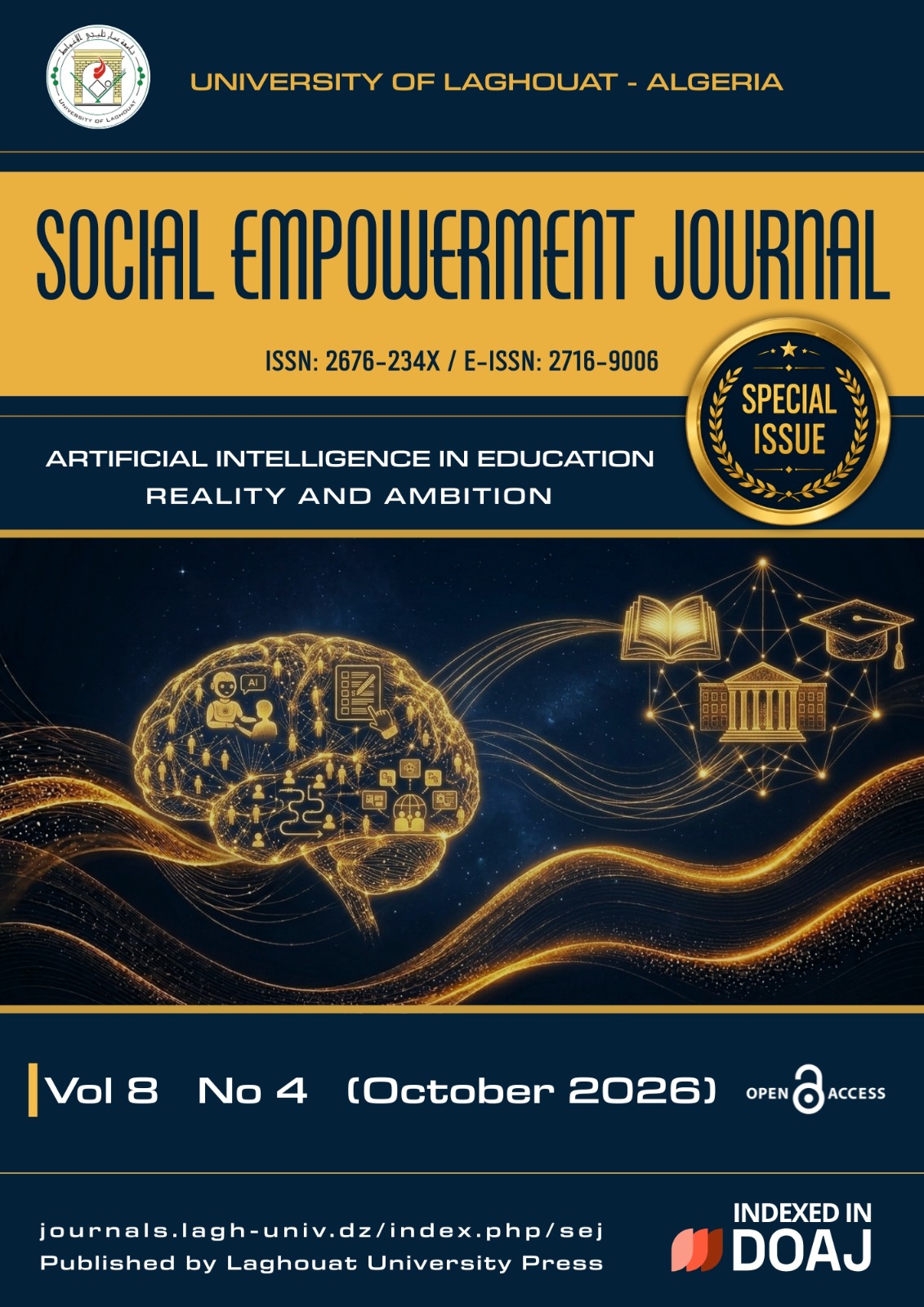
Generative artificial intelligence makes knowledge instantly accessible, shifting the core educational value from what one knows to the ability to learn. This paper argues that metacognitive self-regulation, meaning the capacity to monitor, evaluate, and adjust one's own cognitive processes, is the foundational competence that AI cannot automate. Yet higher education lacks tools to simultaneously develop and document this capacity. We present Aegis-Strategos, a generative AI-powered strategic simulation device that activates metacognitive regulation through a structured comparison mechanism (the Oracle) across six sequential turns. In this exploratory mixed-method study with 15 master’s students (MAE Entrepreneurship & Innovation, Université Marie & Louis Pasteur), the device generated 90 scored interaction traces. One student's trajectory from 40/100 at turn 3 to 95/100 at turn 4, illustrates the complete self-regulated learning cycle in real time: erroneous forethought, AI-detected conceptual confusion, feedback-driven correction, and observable progression. We propose a three-layer theoretical model: cognitive (Anderson & Krathwohl, 2001; Flavell, 1979; Zimmerman, 2002), mechanistic (Nicol, 2021; Sadler, 1989; Carless, 2015), and valorization (Spence, 1973; Hillage & Pollard, 1998; Yorke & Knight, 2006), to show that AI interaction traces can function as credible competence signals in the labor market. The paper concludes that, within the limits of this exploratory study, these devices partially answer both missions of higher education: developing capacities and helping professional integration. If receptor credibility among employers is actively constructed, longitudinal evidence is produced.
Downloads
References
Anderson, L. W., & Krathwohl, D. R. (Eds.). (2001). A taxonomy for learning, teaching, and assessing: A revision of Bloom's taxonomy of educational objectives. Longman.
Bandura, A. (1977). Self-efficacy: Toward a unifying theory of behavioral change. Psychological Review, 84(2), 191–215. https://doi.org/10.1037/0033-295X.84.2.191
Bloom, B. S. (1968). Learning for mastery. Evaluation Comment, 1(2), 1–12.
Boateng, O., & Boateng, B. (2025). Algorithmic bias in educational systems: Examining the impact of AI-driven decision making in modern education. World Journal of Advanced Research and Reviews, 25(1), 2012–2017. https://doi.org/10.30574/wjarr.2025.25.1.0253
Carless, D. (2015). Excellence in university assessment: Learning from award-winning practice. Routledge. https://doi.org/10.4324/9781315740621
Deci, E. L., & Ryan, R. M. (2000). The "what" and "why" of goal pursuits: Human needs and the self-determination of behavior. Psychological Inquiry, 11(4), 227–268. https://doi.org/10.1207/S15327965PLI1104_01
Dweck, C. S. (2006). Mindset: The new psychology of success. Random House.
Facione, P. A. (1990). Critical thinking: A statement of expert consensus for purposes of educational assessment and instruction: The Delphi Report. The California Academic Press.
Flavell, J. H. (1979). Metacognition and cognitive monitoring: A new area of cognitive-developmental inquiry. American Psychologist, 34(10), 906–911. https://doi.org/10.1037/0003-066X.34.10.906
Hattie, J. (2009). Visible learning: A synthesis of over 800 meta-analyses relating to achievement. Routledge. https://doi.org/10.4324/9780203887332
Hillage, J., & Pollard, E. (1998). Employability: Developing a framework for policy analysis (Research Brief No. 85). Department for Education and Employment.
Isaacs, S. (2023). AI in education in the Global South: From design to governance. In F. Miao & W. Holmes (Eds.), AI and the futures of learning. UNESCO.
Marzano, R. J. (2006). Classroom assessment and grading that work. Association for Supervision and Curriculum Development.
McQuaid, R. W., & Lindsay, C. (2005). The concept of employability. Urban Studies, 42(2), 197–219. https://doi.org/10.1080/0042098042000316100
Miao, F., Cukurova, M., Holmes, W., Lee, Y. W., & Huang, R. (2024). AI competency framework for teachers. UNESCO. https://www.unesco.org/en/articles/ai-competency-framework-teachersunesco
Miao, F., Holmes, W., Huang, R., & Zhang, H. (2021). AI and education: Guidance for policy-makers. UNESCO. https://doi.org/10.54675/PCSP7350
Miao, F., Cukurova, M., Holmes, W., Lee, Y. W., & Huang, R. (2024). AI competency framework for students. UNESCO. https://www.unesco.org/en/articles/ai-competency-framework-students
Nicol, D. (2021). The power of internal feedback: Exploiting natural comparison processes. Assessment & Evaluation in Higher Education, 46(5), 756–778. https://doi.org/10.1080/02602938.2020.1823314
Prinsloo, P., & Slade, S. (2017). An elephant in the learning analytics room: The obligation to act. In Proceedings of the 7th International Conference on Learning Analytics and Knowledge (pp. 46–55). ACM. https://doi.org/10.1145/3027385.3027406
Sadler, D. R. (1989). Formative assessment and the design of instructional systems. Instructional Science, 18(2), 119–144. https://doi.org/10.1007/BF00117714
Sen, A. (1999). Development as freedom. Oxford University Press.
Spence, M. (1973). Job market signaling. The Quarterly Journal of Economics, 87(3), 355–374. https://doi.org/10.2307/1882010
Wiliam, D. (2011). Embedded formative assessment. Solution Tree Press.
Winne, P. H., & Perry, N. E. (2000). Measuring self-regulated learning. In M. Boekaerts, P. R. Pintrich, & M. Zeidner (Eds.), Handbook of self-regulation (pp. 531–566). Academic Press.
Yin, R. K. (2018). Case study research and applications: Design and methods (6th ed.). SAGE.
Yorke, M., & Knight, P. T. (2006). Embedding employability into the curriculum: Learning and employability series. Higher Education Academy.
Zimmerman, B. J. (2002). Becoming a self-regulated learner: An overview. Theory Into Practice, 41(2), 64–70. https://doi.org/10.1207/s15430421tip4102_2

This work is licensed under a Creative Commons Attribution-NonCommercial 4.0 International License.